
World Cup 2026 Explainer
How knockout brackets are calculated
How group rankings become knockout slots, why paths shift, and how the simulator advances teams round by round.
4 min read
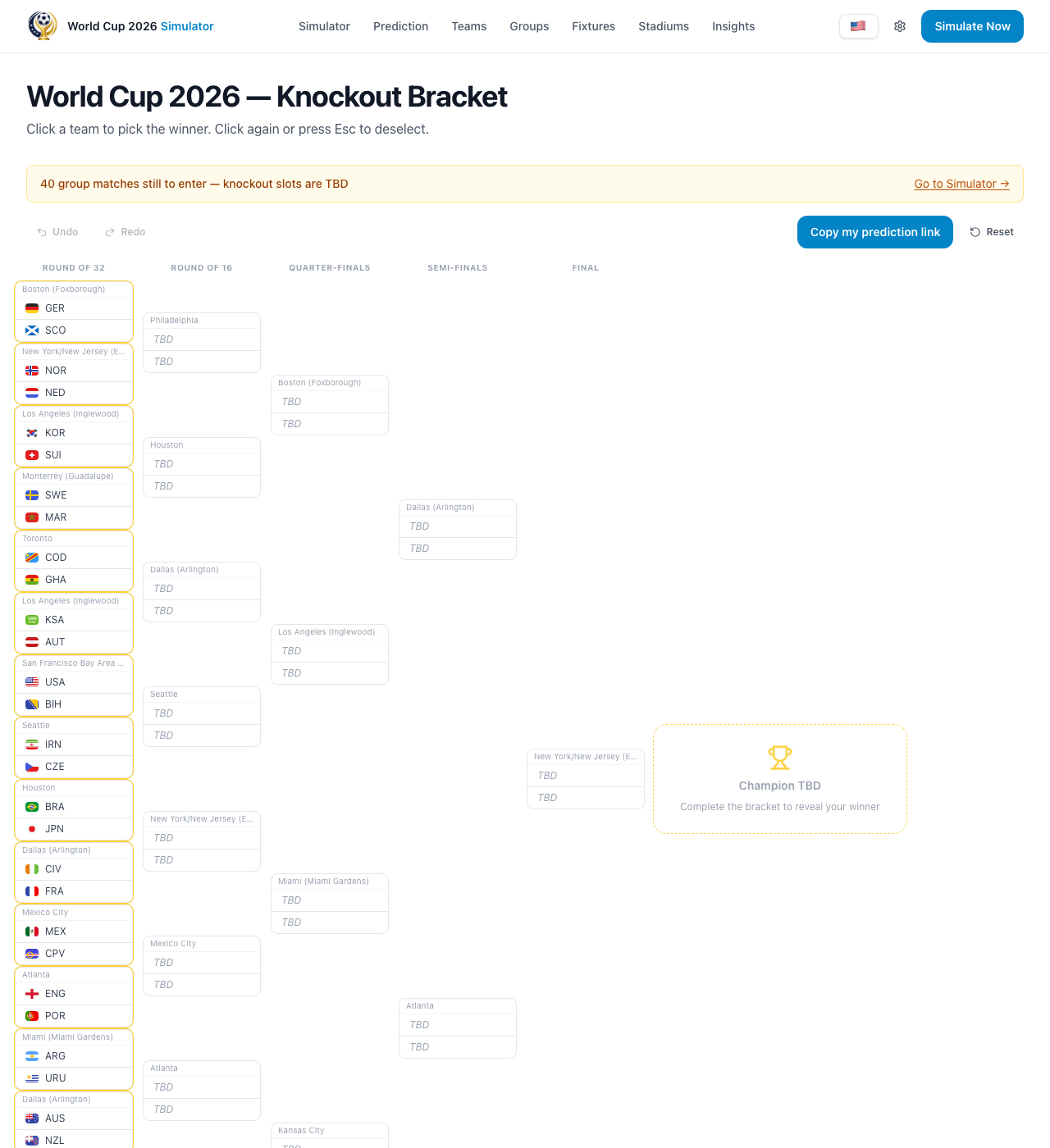
The bracket starts with group placement
Knockout brackets are not calculated from team reputation. They begin with group placement: winners, runners-up, and qualifying third-placed teams are assigned to slots according to the tournament format.
That is why a single group-stage goal can change a team path dramatically. Moving from first to second in a group can mean a different opponent, venue path, and potential quarter-final route.
- Group winners usually receive different bracket slots than runners-up.
- Third-placed qualifiers can create especially sensitive path changes.
- The bracket is a consequence of the group tables, not a separate prediction.
Every knockout pick creates the next match
Once the bracket is seeded, each knockout match has one advancing team. The simulator lets you choose that team directly. The winner moves into the next round, where it may face another team from a different branch.
If you change an earlier pick, downstream rounds may reset or recalculate because the old winner no longer exists in that path. This keeps the bracket internally consistent.
Why bracket paths are useful
A bracket path shows more than a champion. It reveals the story behind the champion: difficult early opponents, favorable branches, surprise semifinalists, and which teams avoid each other until late.
This is the foundation for future Team Paths and Matchups insight pages.
- Team Paths can explain how a nation reaches the final.
- Matchups can compare possible opponents before the bracket is complete.
- Community Trends can show which paths fans pick most often.
Create a new prediction
Your World Cup 2026 bracket prediction.